
Every spring I tell myself the same thing: this year the shed stays organized. And every spring, by the third weekend, the workbench looks like a yard sale hit it. Trowels end up in the flower bed. Pruners live on the shelf under the potting mix. The weeding knife disappears into the grass. The rake handle that cost me a sprained wrist taught me the real lesson. The problem was never that I am messy. It was that every tool had a different home, and none of them were where I happened to be working.
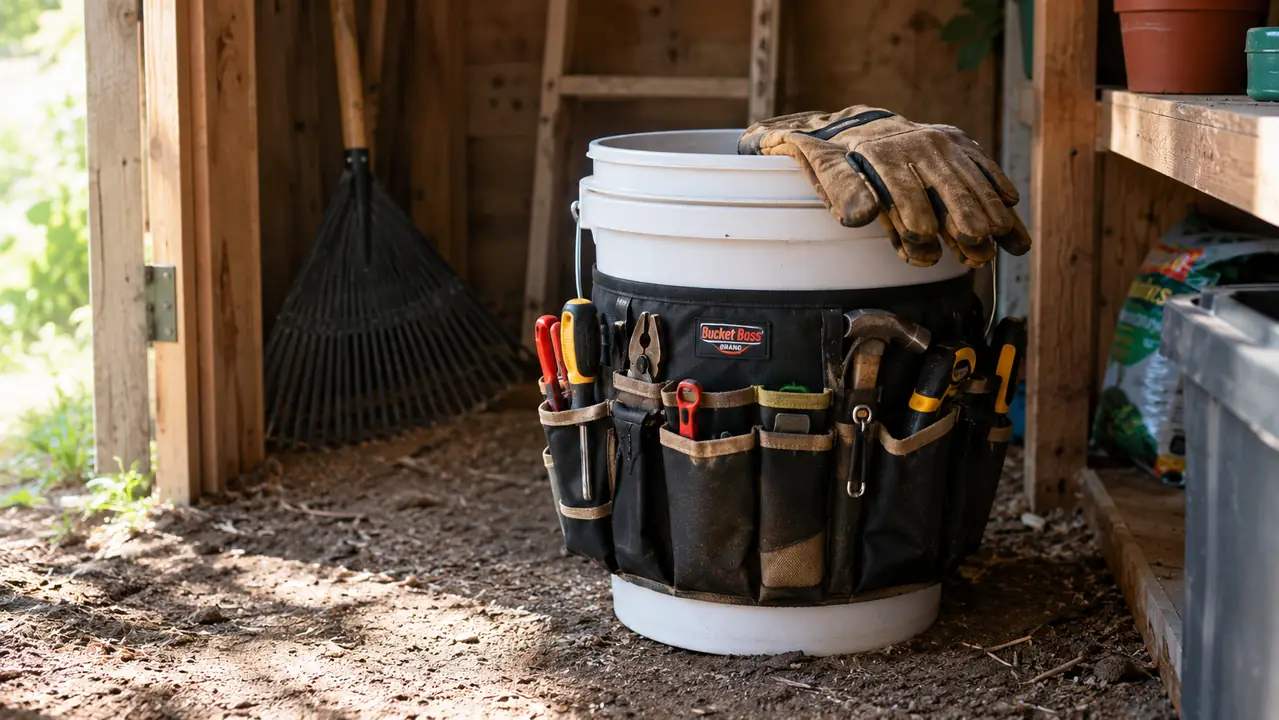
The fix I kept circling back to was a bucket. A five-gallon bucket is cheap, it carries one-handed, and it sits flat on the ground next to the raised beds. The problem was the bucket itself. Tools dumped into it turn into a clatter pile, and you still dig to the bottom for the trowel. The Bucket Boss Bucketeer solves that part. It is a fabric organizer that slips over the rim of a standard five-gallon bucket, with pockets running all the way around. The bucket becomes a tool carrier with a place for everything, and the floor of my shed finally stays clear.
The organizer that finally cleared my shed floor
The Bucket Boss Bucketeer slips onto any standard five-gallon bucket and turns it into a carry-everything tool station. It is the piece I reach for every time I head to the raised beds.
Amazon Check Today's Price on Amazon →What You Need
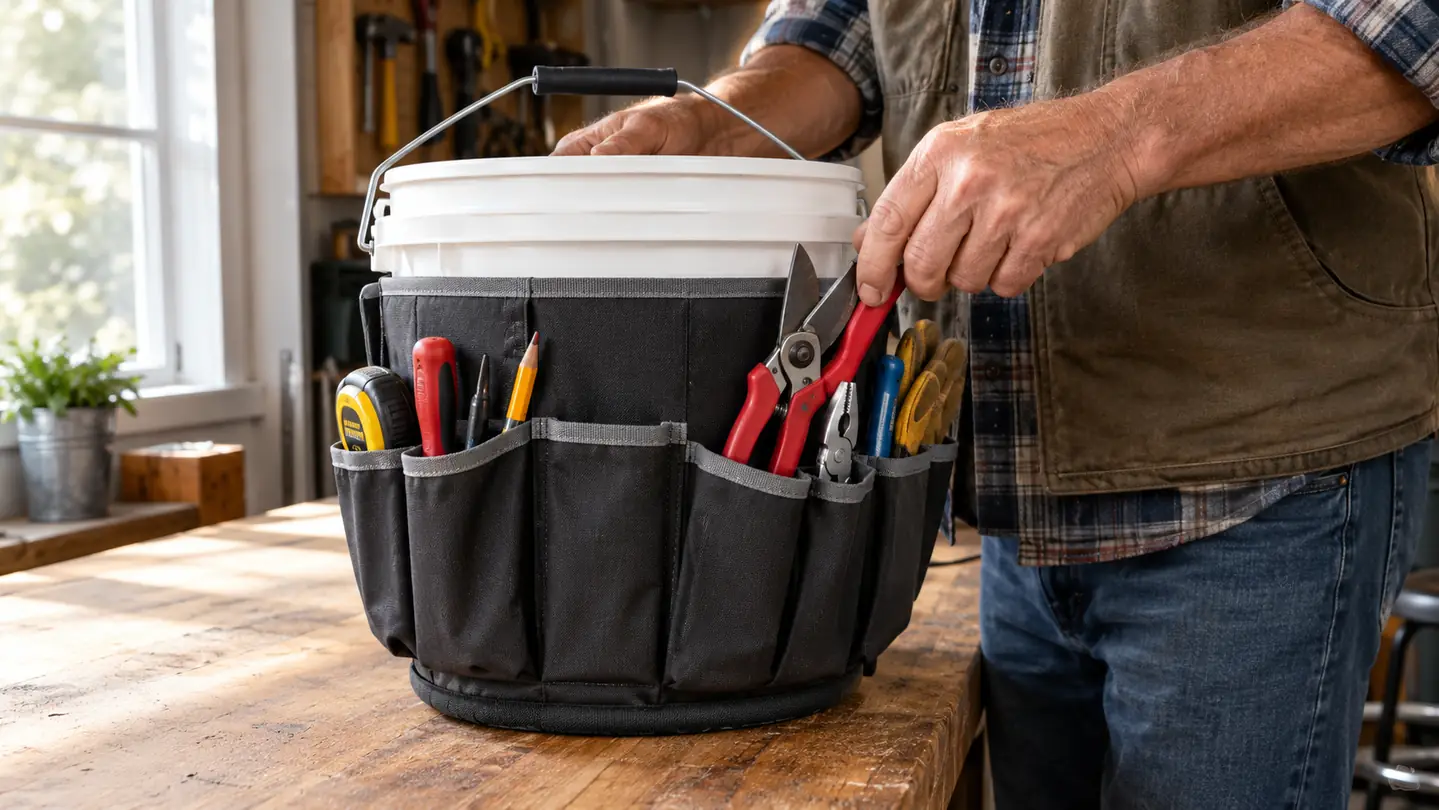
Before you start, gather four things: a standard five-gallon bucket, the Bucket Boss Bucketeer, a rag, and a clear spot on the workbench for sorting. That is the whole list. No special tools, no mounting hardware, no permanent changes to your shed. If you already own a five-gallon bucket, you are halfway there. The organizer slips over the rim and holds itself in place with friction and the weight of what you load into it.
The Bucketeer comes as one piece. There is nothing to assemble, no straps to thread, no buckles to figure out. You drop it over the bucket rim, settle it down so the pockets sit at a comfortable height, and load it. The whole setup took me longer to explain to my neighbor than it did to do.
How I Set Mine Up
Setting it up took me about twenty minutes, and most of that was sorting tools. The steps below are the order I wish I had followed the first time. I did it backwards twice before it clicked.
Step 1: Start With a Clean, Dry Five-Gallon Bucket
The Bucketeer fits a standard five-gallon bucket. Not the squat contractor pail, not the tall one with the pour spout. A plain five-gallon bucket, the kind that held joint compound before you rinsed it out. The organizer grips the rim, so the bucket needs a clean, straight edge.
I scrubbed mine with the hose, let it dry upside down for a day, and wiped the rim with a rag. A damp bucket will rust your tools and mildew the organizer. The first time I rushed it. I loaded everything into a bucket that was still wet inside, and a week later my good pruners had a film of rust on the blades. I cleaned them up and started over. Dry bucket first, every time now.
Keep the bail handle on. The handle is what makes the whole rig portable. You will carry this thing one-handed across the yard, and a bucket without a handle is just a storage bin. If your bucket has a wire handle that flops down, tuck it under the organizer so it stays out of the way when you reach into the pockets.
Step 2: Sort Everything Into Two Piles
Before you put a single tool in the organizer, dump everything on the bench and sort it. Pile one is what you use at least once a week: trowel, hand pruners, weeding knife, transplanter, a pair of gloves. Pile two is the once-a-month stuff: the bulb planter, the soil knife, the extra trowel you bought because you lost the first one.
Be honest about pile two. If you have not touched a tool in a year, it does not belong in the daily bucket. It belongs on a shelf in the shed, or in a box for the next garage sale. The Bucketeer works because it holds the tools you actually reach for. It stops working the moment you cram it full of things you are keeping just in case.
I ended up with eleven items in the daily pile. That sounds like a lot, but the organizer swallowed them without complaint, with room left over for a roll of twine and a spare pack of plant tags. The sorting is the step most people skip, and it is the step that makes everything else work.
Step 3: Load the Deep Pockets First
The organizer has deep pockets and shallow pockets, and they are not interchangeable. Long tools like the weeding knife and the transplanter go in the deep pockets. Small stuff, the twine, the plant tags, the pencil, goes in the shallow pockets. A long tool in a shallow pocket leans, and leaning tools fall out when you carry the bucket.
I learned this the hard way. On my first trip to the raised beds, I wedged the hand pruners into a shallow pocket. Halfway there, they pitched over the rim and landed on the grass. I walked back, picked them up, and reorganized the whole bucket. Now the deep pockets get the long tools and the shallow pockets get the flat stuff.
Load every pocket so the handles point up. You grab a tool by its handle, and if the handle is buried, you are back to digging. Handles up, blades down, and you can find anything by feel without looking. That sounds like a small thing. It is the difference between a bucket you use and a bucket you rummage through.
Step 4: Use the Bucket Itself for the Bulky Stuff
The Bucketeer wraps the outside of the bucket. The inside stays open, and that is where the bulky gear goes. A spray bottle of water, a rolled-up kneeling pad, a small bag of fertilizer, the hand tools that are too big for a pocket. The center of the bucket is the trunk. The pockets are the glove box.
Keep the heavy things low. If you stack a full spray bottle on top of the kneeling pad, the bucket gets top-heavy and tips over when you set it down on the soil. Heavy on the bottom, light on top, and the bucket sits flat. This matters more than it sounds. A tipped bucket spills every pocket at once.
I keep a small plastic tray in the bottom of the bucket for the loose odds and ends: plant tags, a sharpie, the little screwdriver I use to adjust the sprinkler heads. The tray keeps them from sliding under the kneeling pad, and it lifts out in one piece when I need everything at once. You can use an old takeout container for the same job.
Step 5: Park the Bucket Where You Work, and Put It Away the Same Day
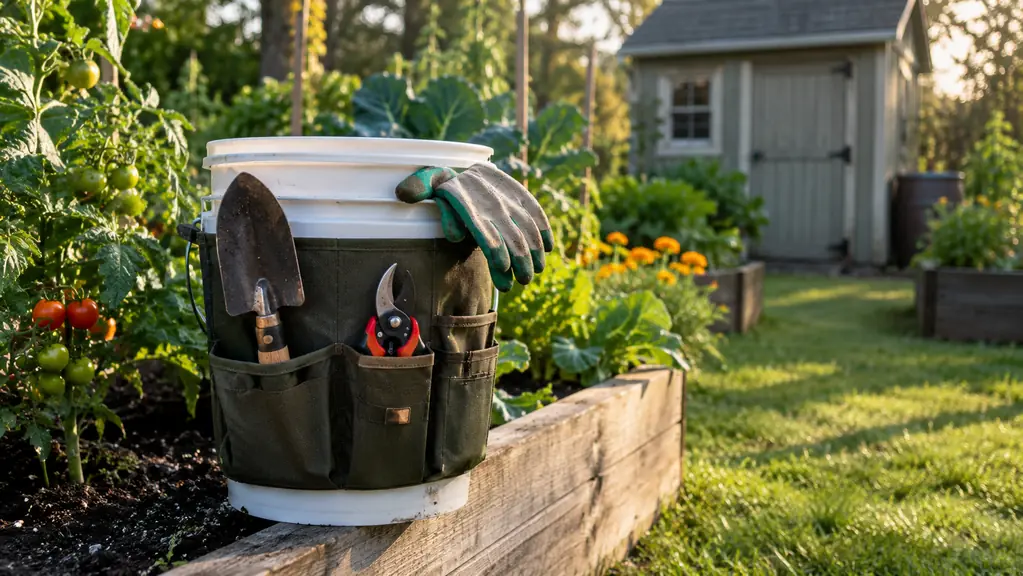
The whole point of the Bucketeer is that the bucket goes where you go. Park it at the edge of the raised bed while you plant. Move it with you when you shift to the perennial border. The tools stay at your feet instead of on a bench twenty feet away, and you stop laying the trowel down in the grass and losing it.
At the end of the day, put everything back in its pocket before you carry the bucket to the shed. It takes ninety seconds. If you skip it, the bucket turns back into a clatter pile by morning, and you are right back where you started. The organizer does not organize itself. That part is still on you.
This is the step I still have to force. I am not a naturally tidy person, and I fought this rule for the first month. But I made a deal with myself: the bucket does not go back in the shed unless every pocket is loaded. The deal has held for two seasons now, and the shed floor has stayed clear enough to walk through without watching my feet.
What I'd Do Differently Next Time
If I were setting this up again, I would buy the organizer before the busy season, not in the middle of it. I set mine up in June, which meant I was sorting tools while the weeds were winning. Doing it on a quiet evening in early spring would have been calmer. I would also sort the tools the night before, when I am not trying to get the planting done before the sun gets high.
The other thing I would change is the bucket itself. Mine is a plain contractor bucket that had held joint compound. It works fine, but a new five-gallon bucket with a smooth rim seats the organizer a little more evenly, and a stiffer handle makes one-handed carries steadier. If your bucket is warped or cracked, replace it before you bother with anything else. A straight, clean bucket is the whole foundation of this setup.
What Else Helps
A few small things made the habit stick. I keep a second five-gallon bucket with its own Bucketeer for the perennial border, so I am not hauling one bucket back and forth across the yard. I hung a hook on the shed wall and the bucket hangs empty by its handle between jobs. And I keep a magnetic tray on the garage workbench for the screws and bits that otherwise live in my pocket. None of these are necessary. The organizer does the heavy lifting. But the little extras are what turn a good setup into a daily habit.
One more thing worth mentioning: the Bucketeer also works on a bucket you already use for something else. I have one on the bucket that holds my sprinkler tools, and the two setups do not get mixed up because each bucket lives in a different part of the shed. If you are not sure whether the organizer will fit your routine, start with one bucket and see if the habit sticks before you buy a second.
The deal has held for two seasons now, and the shed floor has stayed clear enough to walk through without watching my feet.
The Bottom Line
If you have a shed or a garage bench full of hand tools that migrate, the Bucket Boss Bucketeer is a simple fix. It is not magic. It is a pocketed organizer that turns a five-gallon bucket into a carryall, and it only works if you put the tools back. But that one habit, plus the organizer, cleared my floor and cut the time I spend hunting for a trowel down to zero. It is the least fuss I have bought for the garden in years.
Start with one bucket and one organizer. Load it the way I described, park it where you work, and put it away the same day. Give it a full season before you judge it. That is how long it took me to stop reaching for the old hiding spots and start trusting the bucket.
Ready to give your shed floor the same treatment?
The Bucket Boss Bucketeer fits a standard five-gallon bucket and holds everything you reach for in the garden. See today's price on Amazon and decide for yourself.
Amazon Check Today's Price on Amazon →