
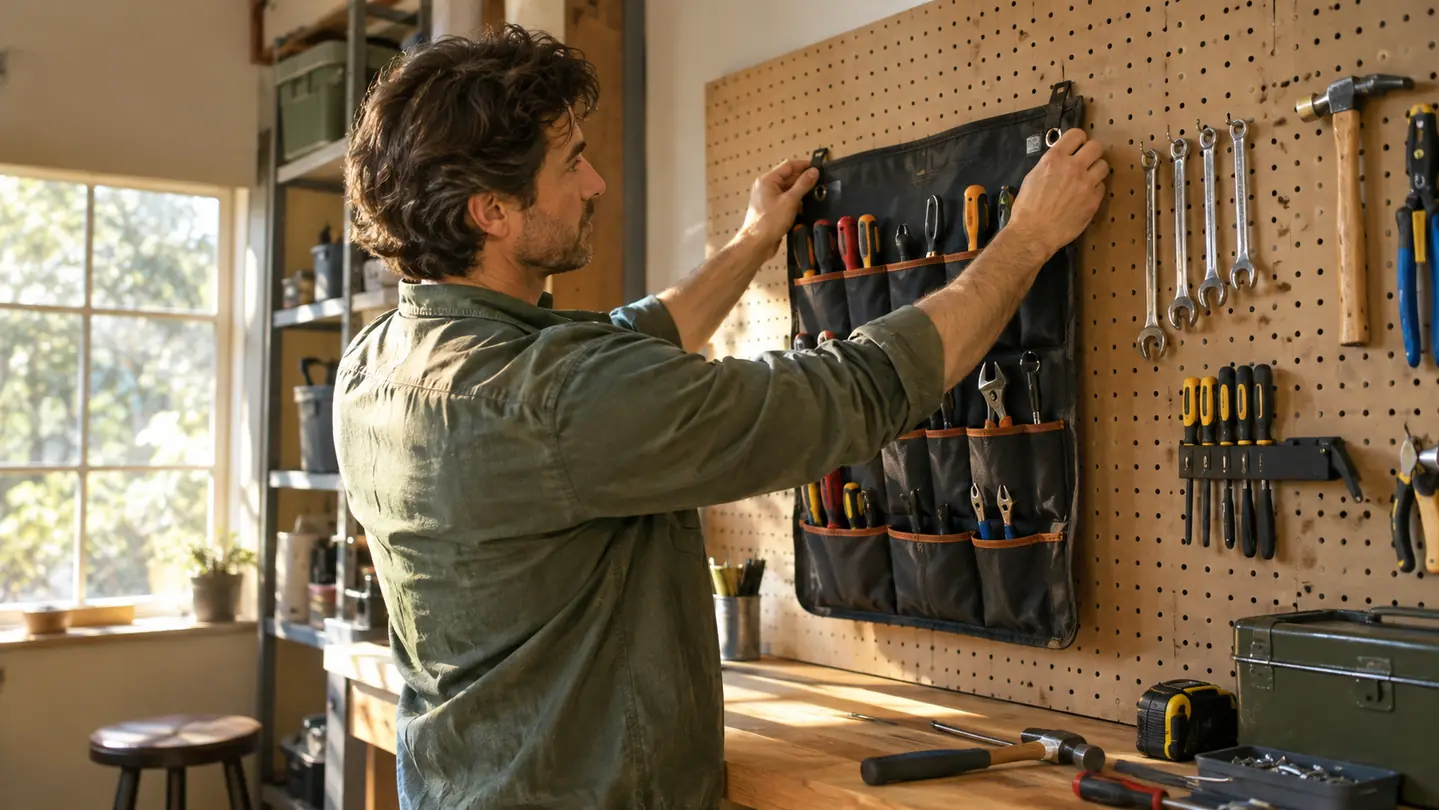
I am 61 years old, and I spent thirty years as a building maintenance supervisor. You would think a man like me would know better than to leave a rake leaning against the shed wall. Last spring I walked in to grab the string trimmer, caught my foot on the handle, and went down hard. That fall cost me a sprained wrist and a week of projects. Carol still brings it up. After that I got serious about getting every long-handled tool off the floor, and the Bucket Boss Bucketeer is the organizer I have used every week since.
The Bucket Boss Bucketeer wraps around a standard five-gallon bucket and gives you a row of deep pockets for hand tools, trowels, pruners, and small parts. It turned a bucket I already owned into a carry-all that hangs on the shed wall when I am done. I have used it through a full growing season, from the first tomato planting in May to the last leaf cleanup in November. Here is what months of real use taught me.
The Quick Verdict
A simple, tough organizer that keeps hand tools off the floor and on the wall. It will not hold long-handled tools, but for trowels, pruners, and daily carry it has earned its spot in my shed.
Amazon Check Today's Price →Stop tripping over tools you use every day
The Bucket Boss Bucketeer fits the five-gallon bucket you already own and hangs flat on the wall when the work is done. See today's price on Amazon.
Amazon Check Today's Price on Amazon →How I've Used It
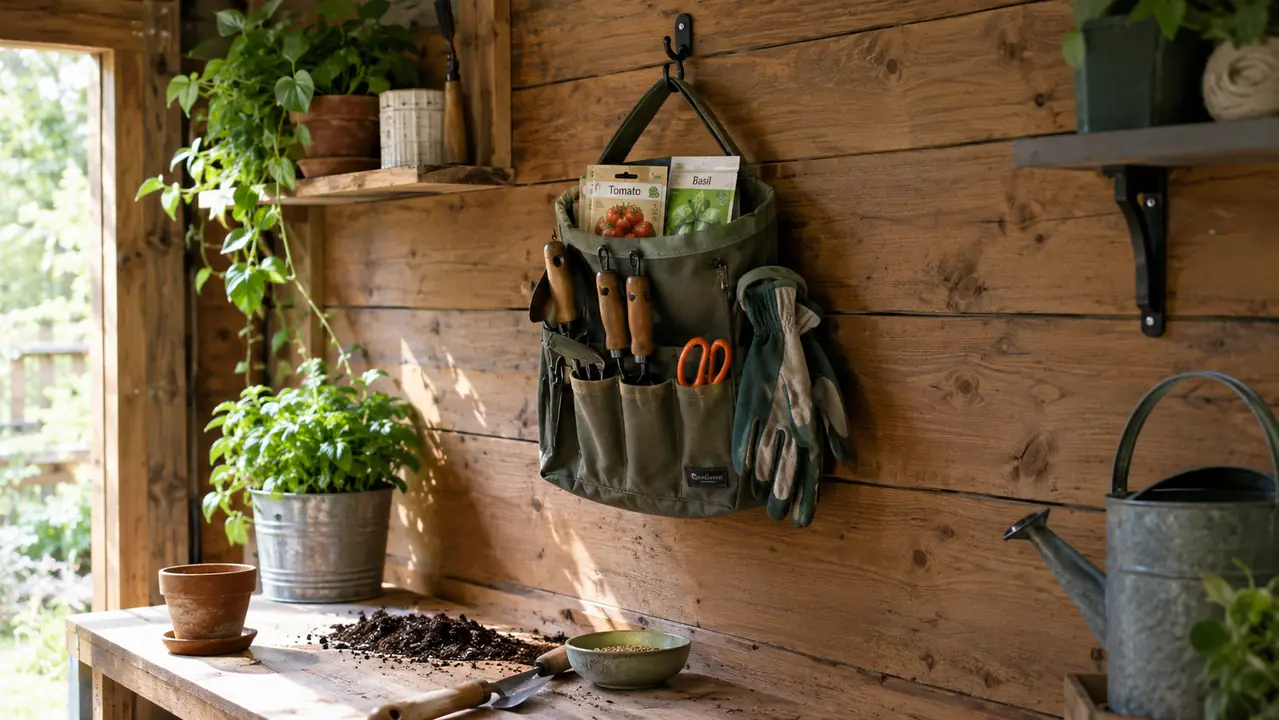
My setup is simple: a two-car attached garage where one bay is my workshop side, and an 8x10 wood garden shed at the back of a quarter-acre lot with raised vegetable beds and a perennial border. The Bucketeer lives in the shed most of the year, hanging from a hook on the wall, and it comes inside to the garage in winter. I mounted the hook myself on the stud to the left of the shed door, about 58 inches off the ground, high enough that the bucket bottom clears the top of my potting bench. The hook is a simple galvanized hook rated for 50 pounds, which is more than enough for a bucket of hand tools.
I fitted it around a standard five-gallon bucket I already had, the kind you get at any hardware store. The organizer cinches around the bucket with a strap, and the whole thing rides on a bucket handle. I loaded it with a trowel, a hand weeder, pruning shears, a small hammer, a screwdriver, and a few packets of seeds. Then I carried it from the shed to the raised beds and back, probably four or five times a week through spring and summer.
The first thing I tried before buying this was a pegboard. I spent a Saturday afternoon putting up a 2x4-foot panel and a dozen hooks, and it worked fine for the tools I hung on it. But my hand tools stayed in a milk crate, and I kept carrying the whole crate to the garden. The Bucketeer did what the pegboard could not: it made the tools portable and still gave them a home on the wall when I was done.
I also tried a canvas tote bag with pockets. That worked until the bottom gave out under a load of wet pruners and a hammer. The Bucketeer has a rigid bucket as its base, so it does not sag or fold. That is the difference that made me stick with it.
The test was not gentle. The bucket sat in the shed through heat and cold, got rained on when I left it out, and got knocked over more than once. One afternoon in July I set it on the tailgate of my truck, drove the quarter mile to the compost pile, and the bucket tipped over on a bump. The tools scattered, but the organizer itself took the hit without a torn pocket or a broken strap. After months of that, the stitching is still tight and the strap still holds. That is the part that surprised me most.
What the Bucket Boss Bucketeer Actually Does
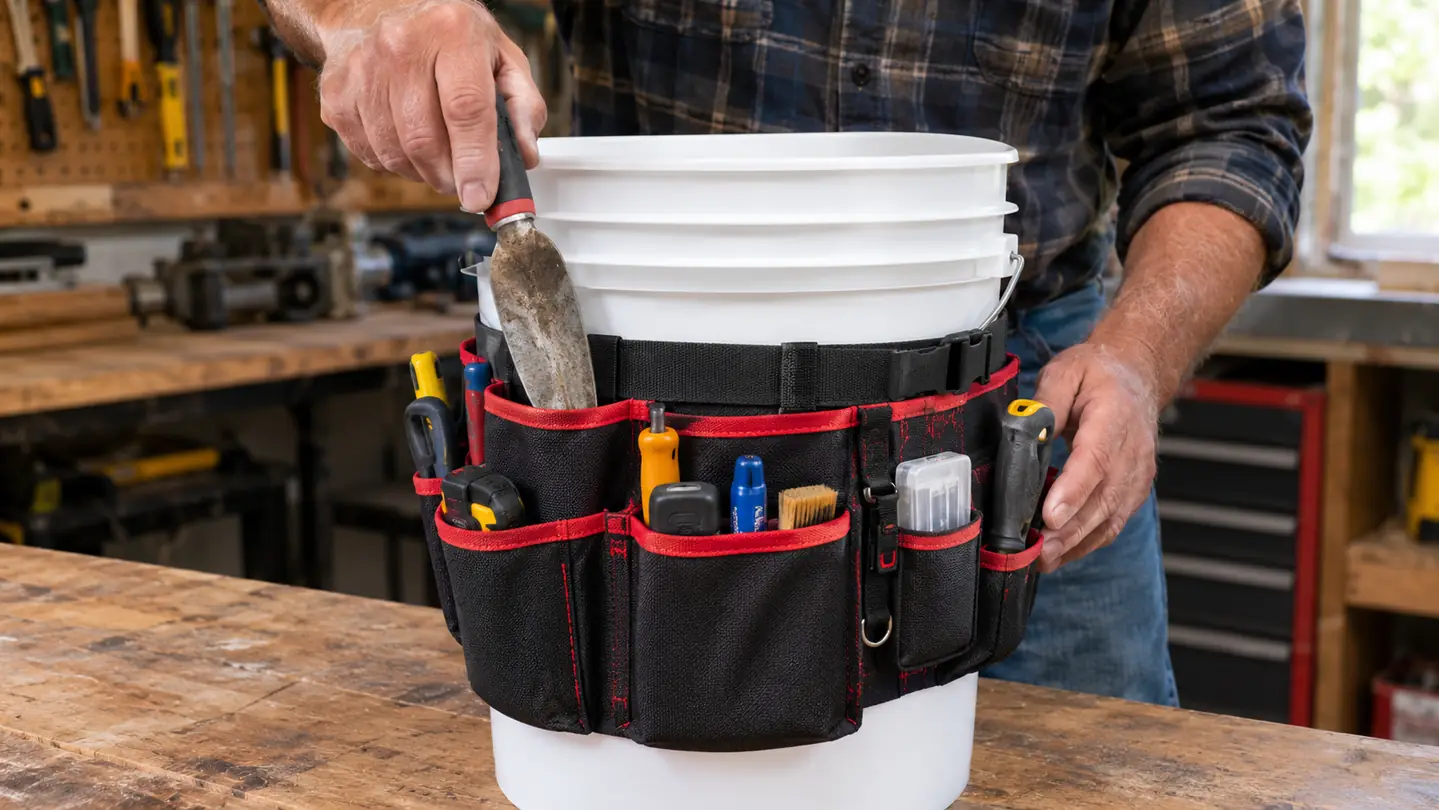
The Bucketeer is a fabric organizer with a row of open pockets that wraps around the outside of a five-gallon bucket. You drop your hand tools into the pockets, and the bucket becomes a portable caddy. When you are done, you lift the bucket by its handle and hang the whole thing on a hook or peg. The whole setup weighs almost nothing on its own; the weight you carry is the tools, not the organizer.
The pockets are deep enough to hold a trowel or a pruner without them sliding out, but shallow enough that you can see what is in each one. I do not have to dig around. That matters when my hands are covered in dirt and I just want the weeder. The pocket openings are reinforced, and the fabric has enough body that an empty pocket does not flop over.
I counted the pockets one morning: there are eight, arranged around the outside of the bucket. I use three for hand tools, two for seed packets and plant tags, one for a small hammer, one for a screwdriver, and one for a roll of twine. I also keep a small trowel sharpening stone in one pocket, so I can touch up an edge without walking back to the garage. The layout is not fancy, but it matches the way I actually work.
The Bucket Boss brand has been making tool organizers for a long time, and it shows in the details. The fabric is heavy, the stitching is reinforced at the stress points, and the strap that cinches around the bucket is simple to tighten and release. There is nothing clever about it, and that is exactly why it works. The strap is a two-inch band with a buckle, and it takes one pull to tighten and one push to release.
One detail I appreciate: the bottom edge of the organizer sits above the bottom of the bucket, so the bucket still sits flat on the ground. You can set the whole thing down without worrying about the fabric getting crushed or the pockets dragging in mud. That sounds small, but it is the reason I reach for it instead of a tool bag.
How It Held Up Over Months of Use
I used the Bucketeer through a full growing season, from early spring planting to fall cleanup. It spent most of that time hanging in the shed, but it also rode in the back of my truck to the compost pile and sat on the workbench in the garage during winter projects. The shed is unheated, so it saw temperatures from below freezing in March to over 95 degrees in August. The bucket is a plain contractor bucket, so I did not worry about it getting scratched or dented.
The fabric has faded a little from sun, but there are no rips, no loose seams, and no broken grommets. The strap still cinches down tight. The pockets still hold their shape, which surprised me because I expected them to sag after months of carrying a heavy trowel and a hammer.
The worst day was a rainy Tuesday in late September. I left the bucket on the workbench near the open garage door, and a storm blew in. The organizer got soaked. I hung it on the shed wall to dry, and within two days it was dry and the stitching had not loosened. I have not treated it with anything; it just dried out on its own.
I also checked the strap where it wraps around the bucket rim. That is the point that takes the most wear, because it carries the whole load when you lift the bucket by the handle. After months of lifting, the strap shows some surface wear but no fraying. The buckle still clicks into place and holds.
One thing I learned the hard way: do not overload the pockets with heavy wrenches and then carry the bucket by the handle across the yard. The weight makes the bucket swing, and the strap can shift. I found this out in June when I loaded it with a pipe wrench, a claw hammer, and a pair of pliers to fix a gate latch. By the time I got to the gate, the organizer had rotated a few inches around the bucket. It did not fall off, but I had to stop and straighten it. For light and medium hand tools it works well. For a full set of heavy wrenches, you want a different setup.
What It Won't Do
The Bucketeer is not a solution for long-handled tools. A rake, a shovel, or a hoe will not fit in the pockets. That was the problem that started this whole project for me, and the Bucketeer did not solve it. I still had to find a separate way to get rakes and shovels off the floor. I ended up mounting two pairs of spring clamps on the shed wall, spaced about 30 inches apart, and the long handles rest in those. The Bucketeer handles the small stuff; the clamps handle the long stuff.
It also will not hold very large or very heavy tools well. A framing hammer fits fine. A sledgehammer does not. If you are a professional contractor carrying a full kit, this is not the organizer for you. It is built for the weekend DIYer and the gardener, and it stays in that lane.
The other limitation is the bucket itself. The Bucketeer needs a standard five-gallon bucket to wrap around. If you do not have one, you will need to buy one. That is not a big cost, but it is an extra step, and the organizer does not come with a bucket. I used a plain contractor bucket that had held joint compound. I rinsed it out, let it dry, and it worked fine. The bucket had a little joint compound residue around the rim, and I sanded it off before fitting the organizer.
There is also no lid and no closure on the pockets. If you turn the bucket upside down, everything falls out. That is fine for how I use it, but if you need a sealed tool box, this is not that. I keep my drill bits and small fasteners in a separate plastic parts box, not in the Bucketeer.
Finally, the Bucketeer does not lock or secure your tools. It is an organizer, not a toolbox. In my shed that is fine. If you are leaving tools on a job site overnight, you still need a lockable box.
What I Liked
- Fits a standard five-gallon bucket you likely already own
- Deep pockets keep trowels, pruners, and small tools from sliding out
- Hangs flat on a shed wall or pegboard when not in use
- Heavy fabric and reinforced stitching held up through a full season
- Simple cinch strap is easy to tighten and release with dirty hands
Where It Falls Short
- Does not hold long-handled tools like rakes or shovels
- Not built for heavy professional tool kits
- Bucket not included
- Strap can shift if you overload the pockets and carry it by the handle
After a full season of heat, rain, and being knocked over, the stitching is still tight and the strap still holds. That is the part that surprised me most.
Who This Is For
This is for the weekend gardener who is tired of kneeling down to find a trowel under a pile of potting soil. It is for the DIYer who wants a portable caddy for the garage, the shed, or the back of the truck. It is for anyone who already owns a five-gallon bucket and wants to make it more useful. If you already have a bucket, the only thing you are adding is the organizer itself.
If you have a small shed like mine, the Bucketeer is a good way to keep hand tools organized without installing a big pegboard. It hangs flat on the wall, takes up almost no space, and you can carry it to the work area in one hand. My shed is 8x10, and wall space is precious. The Bucketeer uses a footprint about the size of a dinner plate.
It is also a good fit if you garden in more than one spot. I carry it from the shed to the raised beds, and sometimes to the perennial border on the other side of the yard. Because it hangs on a bucket handle, I can grab it with one hand and keep the other hand free for a bag of mulch or a drink of water.
Who Should Skip It
Skip it if your main problem is long-handled tools. The Bucketeer will not fix that. You need a wall rack or a dedicated holder for rakes, shovels, and hoes. I learned that the hard way; the Bucketeer is part of my system, not the whole system.
Skip it if you carry a heavy professional kit every day. The Bucketeer is built for light and medium hand tools, not a full set of wrenches. And skip it if you do not want to supply your own five-gallon bucket. The organizer is the easy part; the bucket is on you.
Skip it if you need something that locks or seals. The pockets are open, and the whole thing hangs from a bucket handle. It is not theft-proof and it is not waterproof. For a dry, private shed or garage, that is fine. For an open truck bed or a shared job site, you want something with a lid.
A simple fix for the tools you reach for every day
If your shed is full of loose trowels and pruners, the Bucket Boss Bucketeer is a low-cost way to get them off the floor. Check today's price on Amazon.
Amazon Check Today's Price on Amazon →