
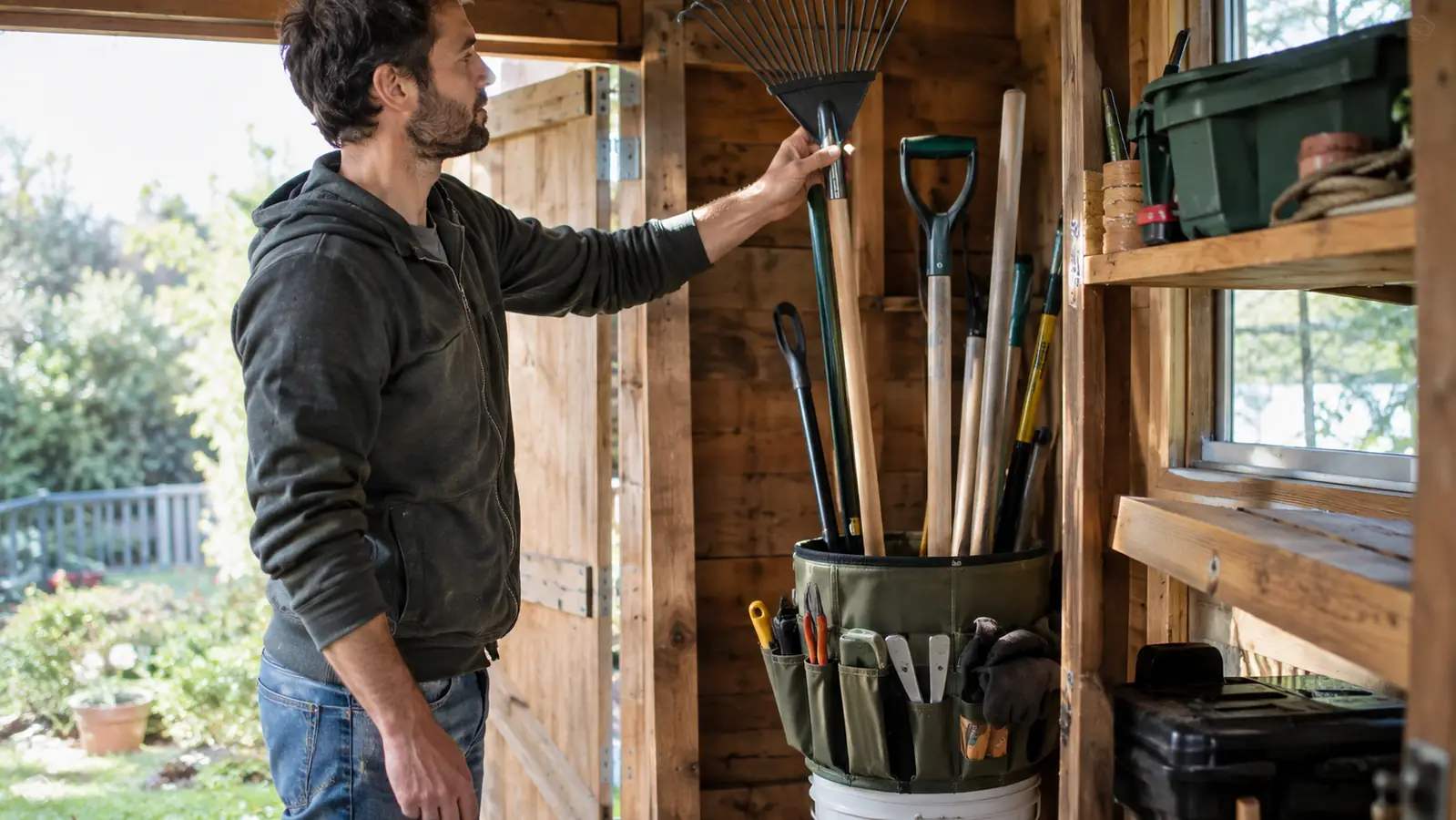
The rake handle that sprained my wrist is still in my shed. I kept it as a reminder. It is a plain wooden handle, the kind you can buy at any hardware store, and it had been leaning against the wall for years. I walked past it one afternoon last spring, caught the handle with my boot, and went down hard enough that I spent the next three weeks doing everything left-handed. That was the day I decided every long-handled tool in my shed was going to live off the floor or it was going to live somewhere else.
I tried a few things first. A pegboard went up on the shed wall, and it worked, until I had more tools than hooks. A wall rack held the shovels but left the hoes and the cultivators leaning in the corner. Then a neighbor showed me the Bucket Boss Bucketeer, which is a fabric organizer that wraps around a plain five-gallon bucket and holds both hand tools and long handles. I bought one, and after eight months of daily use through a full growing season, here is the honest version of what I found, including the parts I had to learn the hard way.
I will be straight with you about how this review works. I bought the Bucketeer with my own money, I have used it for eight months, and I am not going to pretend it is perfect. It has real strengths and real weaknesses. I am going to tell you about both, because that is the review I wanted before I spent my money.
The Quick Verdict
The Bucketeer is the best tool organizer I have used for getting long handles off the floor, but it is not a complete storage system. You supply the bucket, the pockets are not waterproof, and an empty bucket will tip. Know those three things and it earns its place in any shed.
Amazon Check Today's Price →Every long handle in my shed hangs off this organizer. See today's price on Amazon.
The Bucketeer fits a standard five-gallon bucket, holds rakes, shovels, hoes, and hand tools upright, and moves with you from shed to garden. It has limits, and I list every one of them below.
Amazon Check Today's Price on Amazon →How I've Used It
I have one two-car garage, and one car actually lives in it. The other bay is my workshop side, with a workbench and a rolling tool cart. Out back I have an 8x10 wood garden shed at the corner of a quarter-acre lot, with raised vegetable beds along the fence and a perennial border that my wife Carol tends. That shed is where the Bucketeer has spent most of its life.
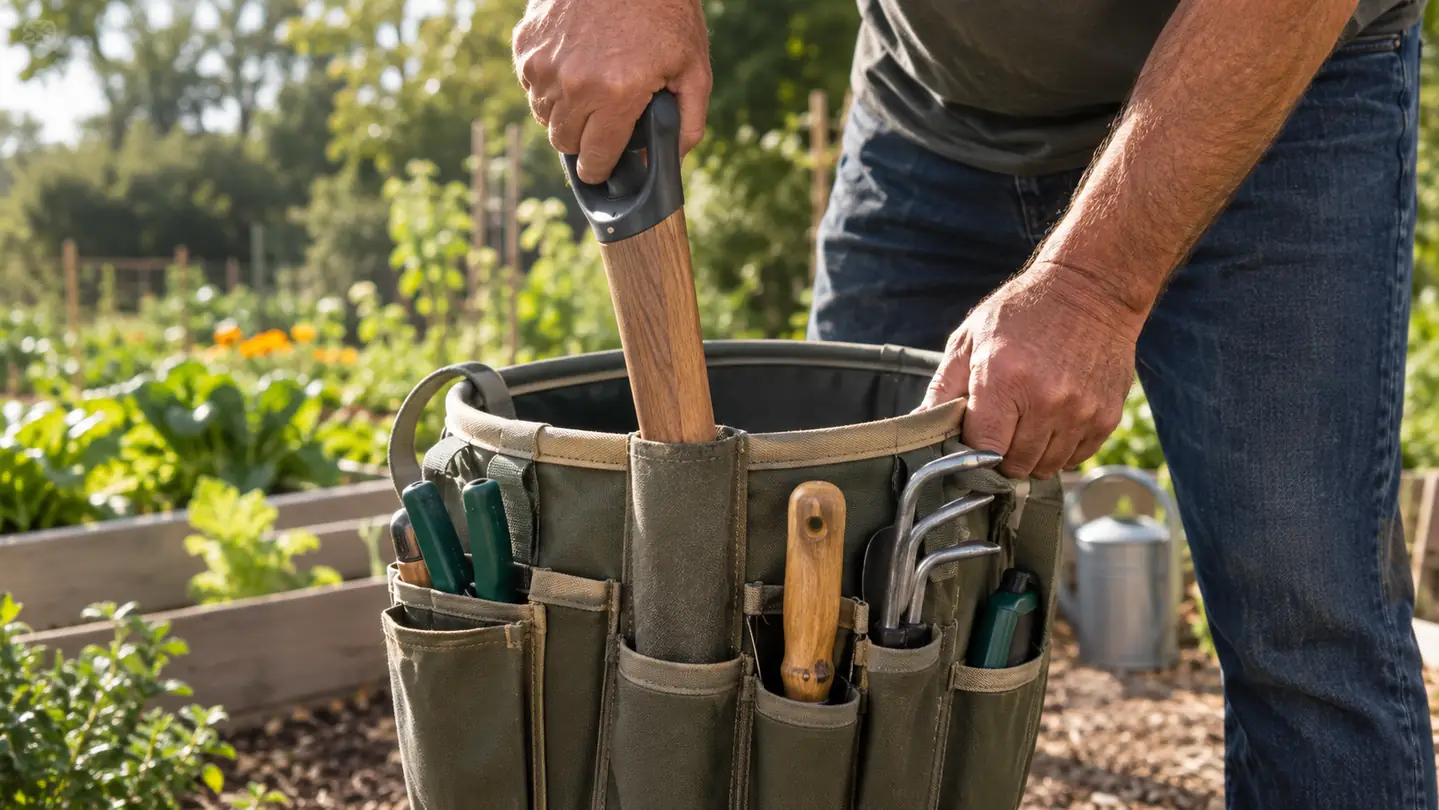
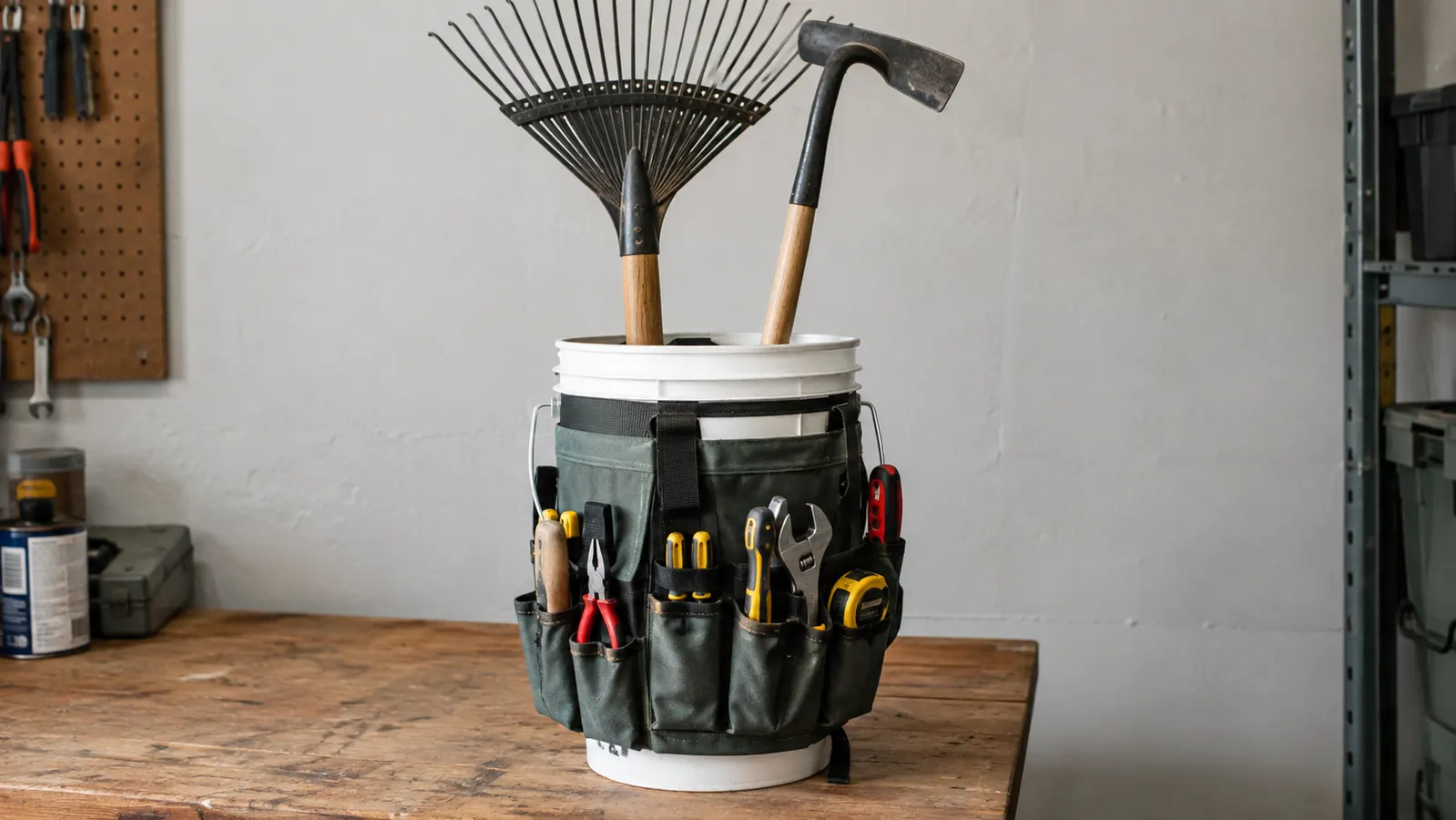
The setup is simple. I took a standard five-gallon bucket, the orange contractor kind, and set the Bucketeer over the top. The organizer hangs down around the bucket like a skirt, with pockets on the outside for hand tools, and it has a padded collar that sits on the bucket rim with a strap that goes over the top handle. A separate holder on the side takes long-handled tools, so rakes and shovels stand upright instead of leaning.
I use it two ways. During the week it lives in the shed with the long handles loaded, so the floor stays clear. On weekends I carry the whole thing, bucket and all, out to the beds and work from it. When I am done, it goes back in the shed. That has been the routine since last April.
The load has changed with the season. In spring it carries the trowel, the hand pruners, a weeder, and a pair of gloves in the top collar, with a rake and a shovel in the long-handle holder. In fall the rake stays and the leaf blower nozzle goes in the bucket. The point is that the Bucketeer does not care what you put in it. It just keeps it off the floor.
What the Bucketeer Actually Is
Bucket Boss makes a whole line of organizers that fit a five-gallon bucket, and the Bucketeer is the one with the long-handle holder. It is an organizer, not a bucket, and that is the first thing to understand. You are buying the cover and the pockets, and you have to supply the bucket yourself. Any standard five-gallon bucket works, but standard covers more variation than you would think. The contractor bucket I used first had a slightly wider rim than a cheap hardware store bucket, and the collar fit differently on each one.
The organizer has three layers of usefulness. The top collar holds hand tools within easy reach, trowels, pruners, a weeder, things like that. The outer pockets swallow larger hand tools and small supplies. And the long-handle holder, which is the part that sold me, keeps rakes, shovels, hoes, and a broom standing upright so nothing touches the floor.
What nobody tells you is that the whole thing is only as stable as the bucket you put it in. An empty bucket with a loaded organizer will tip over. I learned that the first week when I loaded the long-handle side with a heavy shovel and walked away. The bucket went over with a bang. The fix is to put weight in the bucket, a bag of sand or a few bricks, or to keep the heavy tools balanced across the holder.
How I Load Mine
After eight months, I have settled on a load-out that works. The bottom of the bucket holds a one-gallon bag of sand for ballast and a small plastic parts bin with plant tags and twist ties. The top collar holds the tools I reach for most: a trowel, a hand weeder, pruners, and a pair of gloves. The outer pockets take the bigger items, a folding saw, a hammer for fence repairs, and a roll of twine.
The long-handle holder gets the two tools I use every time I go outside: a rake and a shovel. I keep the heavy shovel on the side closest to the bucket handle, because that is the side I grab when I carry it, and the weight balances better. A hoe goes in only when I am working the beds, and I take it out when I am done so it does not crowd the others.
What Nobody Tells You Before You Buy
This is the section I wish someone had written before I bought mine. The Bucketeer is well made, but it has limits. I am going to list the ones that caught me off guard, in the order they happened.
First, the pockets are not waterproof. They are heavy canvas, and they shed light rain for a while, but leave the organizer out overnight in a storm and the tools in the lower pockets will come out damp. I keep mine in the shed, so it has not been a problem for me. If you plan to leave it sitting on a porch or in the back of a truck, plan for it.
Second, the long-handle holder does not lock the tools in place. It holds them upright, but a strong gust of wind or a careless elbow can knock a shovel loose. The tools fall, and if you have a concrete floor, you will hear about it. I added a bungee cord across the handles on windy days, and that solved it.
Third, the strap that goes over the bucket handle is a simple buckle, and it can work loose as you carry the thing. The first few times I carried it by the bucket handle, the organizer slid down the side of the bucket and I had to stop and reset it. After I cinched the strap tight and tucked the excess through the buckle, it stopped happening.
Fourth, the Bucketeer does not make a heavy bucket lighter. Once it is loaded with hand tools, a few long handles, and a bag of sand for ballast, the whole thing weighs a good deal more than you expect. It is fine to carry from the shed to the beds, but it is not a piece of luggage you want to haul across a yard every day. I carry it by the bucket handle, not by the organizer.
And one more thing, and this one is about the bucket, not the organizer. The Bucketeer fits a standard five-gallon bucket, but not every five-gallon bucket is the same. The collar is sized for the common contractor bucket, and it fits that one best. A thinner, cheaper bucket from the discount store will leave the collar loose, and the organizer will sag. If you want the cleanest fit, use a contractor-grade bucket.
How It Held Up Over the Season
Eight months is not a lifetime, but it is a full growing season, and the Bucketeer has been through one. It has been rained on, baked in the sun, dragged across concrete, and loaded with tools that are heavier than the package probably expects. The stitching is still tight, which tells me Bucket Boss built the seams to take a beating. The canvas shows some fading and a few mud stains, but there are no rips and no loose seams.
The collar is the part I expected to fail first, because it takes the most abuse. The padded ring sits on the bucket rim and gets flexed every time you reach into a pocket. After a season of that, it still holds its shape. The long-handle holder has a reinforced section where the tool handles rub, and the fabric there is worn but not worn through.
One thing I will say honestly: I do not leave it loaded in the sun. Canvas fades, and the constant UV exposure will age it faster than normal use. When I am not working, the Bucketeer lives inside the shed, and I think that is a big part of why it still looks as good as it does.
The bottom edge is the other place to watch. The organizer drags on the concrete whenever I set the bucket down, and the hem there has started to fray just slightly. It is cosmetic so far, and the stitching is still holding, but it tells me the bottom edge will be the first thing to go if I keep using it the way I do. I have started setting the bucket down on a scrap of plywood in the garage, and that should slow it down.
Eight months in, every long handle in my shed hangs off that Bucketeer, and my wrist has been fine since the day I set it up.
What I Tried Before
I have tried enough tool storage to have opinions. The pegboard in the garage works for hand tools but does nothing for a six-foot rake. A wall rack for long handles is a good solution if you have wall space and are willing to screw brackets into the studs. I have one in the garage for the tools I use weekly, and it is fine.
The reason I reach for the Bucketeer instead is that it moves. The wall rack holds tools in one place, and the Bucketeer goes where the work is. When I am planting the raised beds, the bucket comes with me, and every tool I need is within arm's reach. When I am done, it goes back to the shed and the floor stays clear.
Compared to a tool bag, the Bucketeer is better for long handles and worse for hauling small parts. A tool bag has a solid bottom and zippers, and it keeps screws and fittings from spilling. The Bucketeer has open pockets, so anything small needs to go in a separate container. I keep a small parts bin inside the bucket for that.
What I Liked
- Gets every long-handled tool off the floor and holds it upright
- Fits any standard five-gallon bucket, so you can swap buckets if one cracks
- Pockets keep hand tools within arm's reach while you work
- Sturdy canvas and stitching held up through a full growing season
- Carries from shed to garden beds as one unit
Where It Falls Short
- Bucket is not included, and the collar fits some bucket rims better than others
- An empty bucket with a loaded organizer will tip over; it needs ballast
- Pockets are not waterproof
- The long-handle holder does not lock tools in place
- The carry strap buckle can work loose and let the organizer slide down
Who This Is For
The Bucketeer is for anyone who is tired of leaning tools against a wall and hoping they stay put. If you have a shed or a garage corner where rakes, shovels, and hoes collect in a pile, and you have tripped over one of them at least once, this organizer fixes that specific problem. It is also a good fit if you garden in more than one spot, because the whole thing moves with you.
And it works well if you are just setting up a first garden and do not want to invest a lot in storage. The Bucketeer turns a bucket you may already own into something that does real work. You can start with one organizer and add a second later if the tool pile grows, which mine did by midsummer.
Who Should Skip It
Skip it if you need a sealed, weatherproof storage solution. The open pockets and canvas fabric are not meant for that. Skip it if you store tools in a place where a tipped bucket would be a hazard, because an under-weighted bucket will tip. And if you already have a wall rack that holds your long handles and you never carry tools away from it, the Bucketeer is solving a problem you do not have.
And skip it if you want a storage system that looks neat on a wall. The Bucketeer is a working tool, not a display piece. It holds a lot, but it looks like what it is: a bucket with a heavy canvas skirt and tools sticking out of the top. If that bothers you, a closed cabinet or a wall rack will suit you better.
The Bottom Line
I have recommended the Bucketeer to two people since I bought mine, and I would buy it again tomorrow. Bucket Boss has earned that much from me. It is not a perfect product, and I have listed every reason why in this review. But it solved the exact problem I bought it for, it has held up through a season of real work, and I have not tripped over a single tool in my shed since the day I set it up. For a retired guy who spends his mornings in the garden, that is what matters.
If your shed floor is a trip hazard, this is the fix I wish I had found sooner.
The Bucketeer holds long handles upright, keeps hand tools in reach, and moves with you from shed to garden. It has limits, and I listed every one of them above. For my money, it is the best tool organizer I have used.
Amazon Check Today's Price on Amazon →